Astrographs: Telescopes Built for Astrophotography
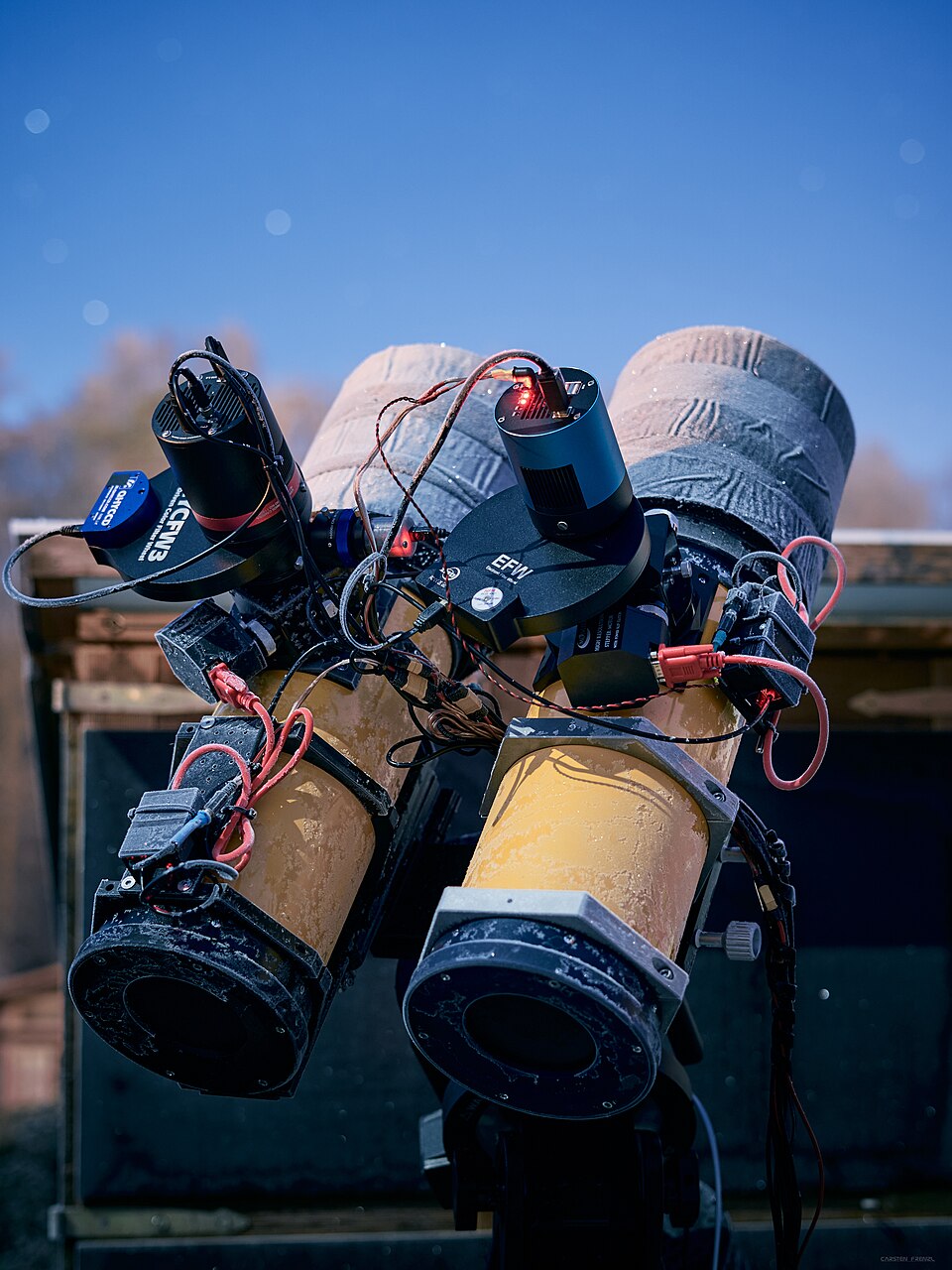

Most telescopes are designed for the eye, which is forgiving: it looks at the center of the field and refocuses without noticing. A camera sensor is flat, records the whole field at once and shows every flaw in the corners. An astrograph is a telescope designed for that job: a flat, sharp field across a large sensor, usually at a fast focal ratio. This guide explains the terms makers use, then lists current astrographs by budget and focal length.
Prices are from High Point Scientific on November 25, 2026, in the Black Friday sales, unless the table says otherwise; sale prices are marked, with the regular price.
The terms, explained
Flat field
A simple refractor or Schmidt-Cassegrain focuses its image onto a curved surface. On a flat sensor, stars in the center are sharp while those near the edges blur or stretch. A field flattener, a lens group fitted in front of the camera, flattens the focal plane. A "flat-field" telescope builds that correction in.
Petzval design
A Petzval telescope has a front lens group plus a second, air-spaced group near the back of the tube. The rear group corrects field curvature and coma, so the field is flat and sharp without a separate flattener. Most compact astrographs use it, including the William Optics RedCat, Takahashi FSQ and Askar SQA series.
Quadruplet, quintuplet
The number of lens elements. A triplet already corrects color well, but leaves a curved field. The fourth and fifth elements flatten the field and reduce coma, so a quadruplet or quintuplet is its own flattener. Some of the elements are usually ED (extra-low dispersion) glass.
Image circle
The diameter of the well-corrected, evenly lit image the telescope delivers. Your sensor's diagonal must fit inside it, or the corners darken and stars distort. A full-frame sensor needs about 43 to 44 mm; an APS-C sensor such as the Sony IMX571 in many deep-sky cameras measures 28.3 mm across. Most current astrographs quote 44 mm or more.
Backfocus
Flatteners, reducers and coma correctors need the sensor at an exact distance behind their rear thread. The industry standard is 55 mm, the distance a DSLR on its T-ring naturally sits at, but not every optic uses it: ZWO's FF70 needs 82.5 mm from its M48 thread, and Celestron's RASA 11 V2 lists 72.8 mm in total. Petzvals with built-in correction often need no spacing at all; you simply focus. See camera adapters for how spacers work.
RASA and f/2 optics
The Rowe-Ackermann Schmidt Astrograph (RASA) is Celestron's imaging-only descendant of the Schmidt camera. The camera sits at prime focus at the front of the tube, so a RASA cannot be used for visual observing, and built-in correctors give a flat field at f/2 (RASA 8) or f/2.2 (RASA 6, 11 and 14). Sky-Watcher's HAC125DX, launched in 2026, is another f/2 design.
Why fast optics suit CMOS cameras
A lower f-number puts more light on each pixel per second, so each exposure can be much shorter: Celestron contrasts an f/2 RASA with an f/10 telescope. Short exposures make tracking errors matter less, often remove the need for guiding, and suit the many-short-frames style of modern CMOS cameras. Celestron names one-shot color CMOS cameras and mirrorless cameras as good matches.
Current astrographs at a glance
| Astrograph | Design | Aperture / focal length | f-ratio | Image circle | Price |
|---|---|---|---|---|---|
| ZWO FF70 | Flat-field quadruplet | 70 / 490 mm | f/7 | 44 mm | $539 sale at ZWO US (regular $599) |
| Askar 71F | Flat-field quadruplet | 71 / 490 mm | f/6.9 | 44 mm | $569.05 sale (list $599) |
| Askar SQA55 | Petzval quintuplet | 55 / 264 mm | f/4.8 | 44 mm | $755.25 sale (list $795) |
| William Optics RedCat 51 Gen 3 | Petzval quadruplet | 51 / 250 mm | f/4.9 | 45 mm | $834.10 sale (list $878) |
| Askar FRA400 | Petzval quintuplet | 72 / 400 mm | f/5.6 | 44 mm | $850.25 sale (list $895) |
| Sky-Watcher HAC125DX | Catadioptric astrograph | 125 / 250 mm | f/2 | not published | $899 (Oct 2026) |
| Sky-Watcher Quattro 10" | Newtonian + coma corrector | 254 / 1,000 mm | f/4 | not published | $1,099 sale (list $1,325) |
| William Optics RedCat 61 | Petzval quadruplet | 61 / 300 mm | f/4.9 | covers full frame | $1,147.60 sale (list $1,208) |
| Sky-Watcher Esprit 70EDX | Triplet + flattener | 70 / 490 mm | f/7 | 44 mm | $1,149 sale (list $1,295) |
| ZWO FF110 | Petzval flat-field quadruplet | 110 / 766 mm | f/7 | 44 mm | $1,349 sale (list $1,499) |
| Celestron RASA 6 | RASA | 152 / 335 mm | f/2.2 | not published | $1,699 (Oct 2026) |
| Celestron EdgeHD 8 | Flat-field SCT | 203 / 2,032 mm | f/10 | 42 mm | $1,699 |
| Sky-Watcher Esprit 100EDX | Triplet + flattener | 100 / 550 mm | f/5.5 | 44 mm | $1,879 sale (list $2,095) |
| Askar FRA600 | Petzval quintuplet | 108 / 600 mm | f/5.6 | 66 mm | $2,469.05 sale (list $2,599) |
| Celestron RASA 8 | RASA | 203 / 400 mm | f/2 | 22 mm | $2,599 imaging kit (sold out) |
| William Optics RedCat 91 | Petzval quintuplet | 91 / 448 mm | f/4.9 | 55 mm | $2,715.10 sale (list $2,858) |
| Sky-Watcher Esprit 120EDX | Triplet + flattener | 120 / 840 mm | f/7 | 44 mm | $2,999 sale (list $3,295) |
| William Optics Ultra-Cat 108 | Astrograph | 108 / 518 mm | f/4.8 | not published | $3,998 (Oct 2026) |
| Celestron RASA 11 V2 | RASA | 279 / 620 mm | f/2.2 | 43.3 mm | $4,499 (back-ordered) |
"Oct 2026" prices are from Astronomy magazine's Star Products list of October 2026, not a store page. The Esprit EDX image circles are with Sky-Watcher's optional flattener. The Quattro needs a coma corrector ($490 for Sky-Watcher's own).
Picks by budget and focal length
Under $1,000: a first astrograph
- Short focal length (250-400 mm), for large nebulae and Milky Way fields: the RedCat 51 Gen 3 is small and has an internal focuser, so it rides on a small mount and needs no backfocus calculation. The Askar SQA55 and FRA400 are the alternatives; the FRA400 takes an optional 0.7x reducer to 280 mm at f/3.9.
- Around 500 mm, for mid-size nebulae and big galaxies: the ZWO FF70 and Askar 71F are the cheapest flat-field quadruplets here, both with a 44 mm image circle.
- Fast: the HAC125DX gives f/2 for $899. Sky-Watcher does not publish its image circle, so check it against your sensor.
$1,000 to $2,500: the main workhorses
- The Esprit 100EDX (550 mm f/5.5) is the 2026 version of a long-standing all-round imaging refractor; it weighs 7.26 kg.
- The ZWO FF110 (766 mm f/7) reaches smaller targets at 6.76 kg.
- The Askar FRA600 (600 mm f/5.6) has a 66 mm image circle, enough for sensors larger than full frame.
- The RASA 6 is the smallest RASA; Celestron also uses this optical design inside its Origin Mark II smart telescope. See smart telescopes.
- For small galaxies and planetary nebulae, the EdgeHD 8 gives 2,032 mm with a flat field, or 1,422 mm at f/7 with its 0.7x reducer. It needs a sturdy mount and good guiding.
Above $2,500
The RedCat 91, Esprit 120EDX and 150EDX ($4,299 sale, list $4,795), the RASA 11 V2 and 14 ($14,999), the Ultra-Cat 108 and Askar's new SQA130 (130 mm f/4.8, $4,799 in October 2026) serve larger sensors and longer focal lengths. Takahashi's FSQ-85EDX (450 mm f/5.3 Petzval, 44 mm image circle) is the premium choice in this class; US prices we found were undated and varied widely, so check with a dealer.
Imaging Newtonians
A fast Newtonian such as the Quattro 10" gives the most aperture per dollar, but needs a coma corrector, regular collimation and a heavy mount (the 10" tube weighs 16.6 kg). Takahashi's Epsilon series (the Epsilon-160ED is 530 mm at f/3.3) is the premium version.
New in 2025-2026
- Sky-Watcher Esprit EDX (70, 100, 120 and 150 mm), the next generation of the Esprit ED.
- ZWO FF70, FF90, FF110 and FF131, a new line of flat-field quadruplets.
- Sky-Watcher HAC125DX, a $899 f/2 astrograph.
- William Optics Ultra-Cat 108 and Askar SQA130, both on Astronomy's 2026 Star Products list.
- Takahashi FSQ-80FC, a quintuplet with two fluorite elements (450 mm f/5.6, 50 mm image circle, according to Takahashi America), announced around March 2026.
Discontinued and ending models
| Model | Status (November 25, 2026) | Replacement |
|---|---|---|
| ZWO FF65, FF80, FF107, FF130 | Shown out of stock beside the new line on ZWO's site; Agena Astro lists the FF65 as discontinued. ZWO has not announced the end of the others. | FF70, FF90, FF110, FF131 |
| Askar FRA300 Pro | High Point Scientific says Askar is no longer producing it and was selling the last units at $499.95 (list $949.95). | Askar SQA55 or FRA400 |
| Askar FRA500 | Half price ($999.95, list $1,999) and sold out with no back orders at High Point Scientific, which suggests it may be ending. | Askar FRA600 |
| Sky-Watcher Esprit 100ED | Replaced; its old product pages are gone. | Esprit 100EDX |
| Takahashi FSQ-106EDX4 | Agena Astro lists it as discontinued and First Light Optics as unavailable; Takahashi has not confirmed. | FSQ-85EDX or FSQ-80FC |
| Radian Raptor 75 | One European retailer lists it as no longer available; not confirmed elsewhere. | none named |
Before you buy
- Check the image circle against your sensor diagonal before the price. A 22 mm image circle (RASA 8) is too small for an APS-C sensor's 28.3 mm.
- Work out the backfocus for your camera and filter setup, or choose a Petzval that needs none.
- Weigh the whole kit (telescope, camera, filter wheel, guide scope) and pick a mount rated well above it. See mounts for astrophotography.
- Solar imaging needs a proper solar filter over the front of the telescope. Never point a telescope at the Sun without one.
- For general advice on aperture and focal ratio, see telescopes for astrophotography.
Sources
- highpointscientific.com/astronomy-hub/post/astro-photography... (Petzval and flat-field designs, image circle, about 43 mm for full frame)
- celestron.de/blog/rasa-rowe-ackermann-schmidt-astrograph (RASA as Schmidt-camera successor, f/2 and f/2.2, shorter exposures, suits CMOS and mirrorless cameras)
- highpointscientific.com/celestron-36cm-rasa-ota-v2-w-usfs-91... (RASA 14 specs and price; RASA cannot be used visually)
- optcorp.com/blogs/deep-sky-imaging/how-to-set-the-correct-ba... (55 mm is an industry-standard backfocus)
- us.zwoastro.com/products/ff70-apo-flat-field-apochromatic-re... (ZWO FF70 specs, 82.5 mm backfocus from M48 thread, $539 sale (regular $599))
- highpointscientific.com/askar-71f-flat-field-refractor (Askar 71F specs and price)
- highpointscientific.com/askar-sqa55-quintuplet-refractor (Askar SQA55 specs and price)
- highpointscientific.com/askar-fra400c-quintuplet-apo-refract... (Askar FRA400 specs, price, 0.7x reducer)
- highpointscientific.com/william-optics-redcat-51-gen-3-apo-f... (RedCat 51 Gen 3 specs and price)
- highpointscientific.com/william-optics-wifd-redcat-61-refrac... (RedCat 61 specs and price)
- highpointscientific.com/william-optics-wifd-redcat-91-apo-re... (RedCat 91 specs and price)
- highpointscientific.com/sky-watcher-espirt-edx-70-super-apo-... (Esprit 70EDX specs and price)
- highpointscientific.com/sky-watcher-espirt-edx-100-super-apo... (Esprit 100EDX specs and price)
- highpointscientific.com/sky-watcher-espirt-edx-120-super-apo... (Esprit 120EDX specs and price)
- highpointscientific.com/sky-watcher-espirt-edx-150-super-apo... (Esprit 150EDX price)
- firstlightoptics.com/takahashi-epsilon-reflector-telescopes.... (Takahashi Epsilon series still listed)
- skywatcher.com/post/advertisement/esprit-edx-series (Esprit EDX series (2026))
- highpointscientific.com/zwo-110-mm-apo-refractor-telescope (ZWO FF110 specs and price)
- zwoastro.com/product-category/multiple-choice (new FF70/FF90/FF110/FF131 line beside old FF65/FF80/FF107/FF130, out of stock)
- agenaastro.com/zwo-ff65-apo-refractor-telescope-discontinued... (Agena lists the ZWO FF65 as discontinued)
- highpointscientific.com/askar-fra600-108-mm-quintuplet-apo-a... (Askar FRA600 specs and price)
- highpointscientific.com/askar-90-mm-quintuplet-apo-astrograp... (Askar FRA500 at half price, sold out)
- highpointscientific.com/askar-60-mm-f5-quintuplet-flat-field... (Askar no longer producing the FRA300 Pro; clearance price)
- highpointscientific.com/skywatcher-10-inch-f4-newtonian-refl... (Quattro 10-inch f/4 specs, price, coma corrector)
- highpointscientific.com/celestron-8-inch-rowe-ackermann-schm... (RASA 8 specs, 22 mm image circle, sold out)
- highpointscientific.com/celestron-11-rasa-v2-w-ultra-stable-... (RASA 11 V2 specs, 72.8 mm backspacing, price)
- highpointscientific.com/celestron-edgehd-8-ota-8-quot-f-10-a... (EdgeHD 8 flat field, 42 mm image circle, price)
- astronomy.com/observing/our-16th-annual-star-products (RASA 6, Sky-Watcher HAC125DX, William Optics Ultra-Cat 108, Askar SQA130 specs and prices (October 2026))
- takahashi-europe.com/catalog/refractors/wide-field-astrograp... (Takahashi FSQ-85EDX specs)
- firstlightoptics.com/takahashi-fsq-series-refractor-telescop... (Takahashi FSQ-85EDX and FSQ-80FC listed in the UK)
- takahashiamerica.com/products/fsq-80fc-refractor-telescope (Takahashi FSQ-80FC specs)
- firstlightoptics.com/all-telescopes/takahashi-fsq-106edx4-f5... (FSQ-106EDX4 unavailable)
- us.zwoastro.com/products/asi2600mc-mm-air (APS-C IMX571 sensor diagonal 28.3 mm)