Best Smart Telescopes in 2026
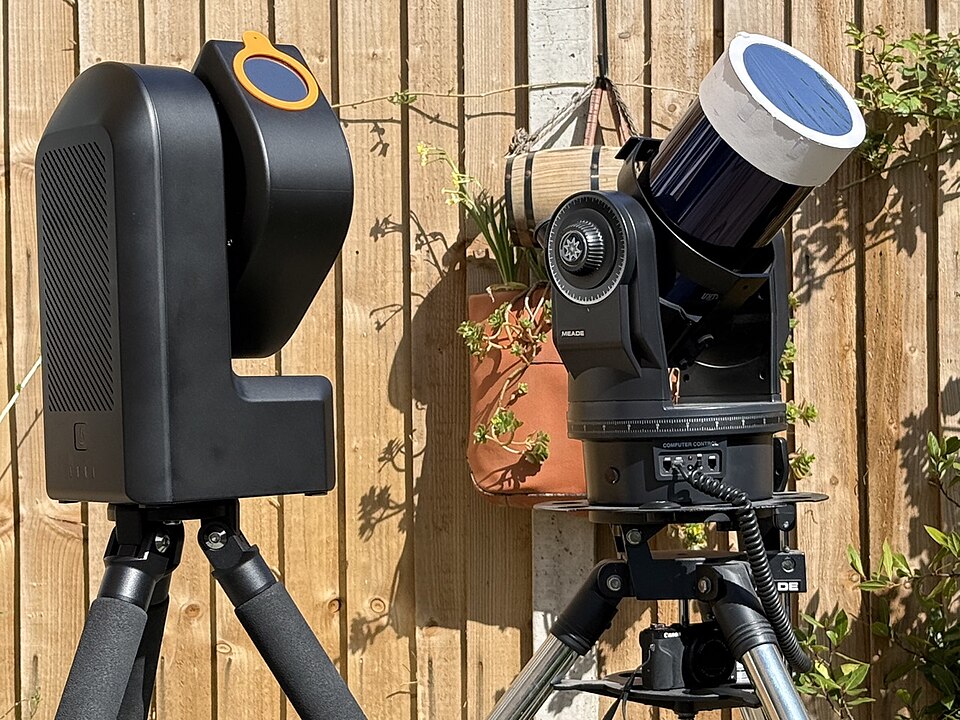

A smart telescope is a small telescope, camera, motorized mount and computer in one box, run from a phone or tablet. If you are new to them, start with what a smart telescope is and how they work. This page compares the models you could buy new in late 2026.
How we chose. Every telescope below was on sale new on November 25, 2026, from its maker or a large dealer. The specifications come from the makers' own pages and manuals; where a maker does not publish a figure, we give a dealer's or a review's figure and say so. Prices are those at the maker's store or at High Point Scientific on November 25, 2026, the week of Black Friday, so many are sale prices; they are marked, with the regular price where the store showed one. Prices change often.
The picks at a glance
| Pick | Telescope | Price (Nov 25, 2026) | Why |
|---|---|---|---|
| First smart telescope | ZWO Seestar S30 Plus | $474 on sale ($499 regular) | Low price, solar filter included, EQ mode and mosaics |
| Smallest and lightest | DWARF mini | $419, about $339 on sale | 840 g, the smallest complete smart telescope here |
| Widest fields | ZWO Seestar S30 Pro | $664 on sale ($699 list) | 4.6° field, Milky Way panoramas |
| Best all-rounder | ZWO Seestar S50 Pro | $999 | 50 mm apochromat, 8.3 MP sensor, up to 9 h battery |
| Premium refractor | Vaonis Vespera Pro 2 | $2,490 on sale ($2,990 list) | 12.5 MP square sensor, 11 h battery, 5-year warranty |
| Largest aperture | Celestron Origin Mark II | $4,299 | 152 mm f/2.2 RASA |
| With an eyepiece | Unistellar eVscope 2 | $3,999 on sale ($4,999 regular) | 114 mm, electronic eyepiece, citizen science |
All current models compared
| Telescope | Aperture | Focal length | f-ratio | Main sensor | Field of view | Weight | Battery | Price (Nov 25, 2026) |
|---|---|---|---|---|---|---|---|---|
| ZWO Seestar S30 Plus | 30 mm | 160 mm | f/5.3 | SmartSens SC485SL, 2560 × 1440 | 3° | 1.65 kg | up to 6 h | $474 sale ($499) |
| ZWO Seestar S30 Pro | 30 mm | 160 mm | f/5.3 | Sony IMX585, 3840 × 2160 | 4.6° | 1.65 kg | 6 h | $664 sale ($699) |
| ZWO Seestar S50 Pro | 50 mm | 260 mm | f/5.2 | OmniVision OS08B10, 3840 × 2160 | 2.8° | 2.8 kg | up to 9 h | $999 |
| DWARF mini | 30 mm | 150 mm | f/5 | Sony IMX662, 1920 × 1080 | 2.5° × 2.14° | 0.84 kg | about 4 h | $419 (about $339 sale) |
| DWARF 3 | 35 mm | 150 mm | f/4.3¹ | Sony IMX678, 3840 × 2160 | about 3° | 1.35 kg | up to 5.5 h | $549 |
| Vaonis Vespera II | 50 mm | 250 mm | f/5 | Sony IMX585, 3840 × 2160 | 2.5° × 1.4° | 5 kg | about 4 h | $1,490 sale ($1,590) |
| Vaonis Vespera 3 | 50 mm | 245 mm | f/4.9 | Sony IMX585, 3840 × 2160 | 2.6° × 1.4° | 5 kg | 11 h | $1,990 sale ($2,490) |
| Vaonis Vespera Pro 2 | 50 mm | 245 mm | f/4.9 | Sony IMX676, 3536 × 3536 | 1.6° × 1.6° | 5 kg | 11 h | $2,490 sale ($2,990) |
| Unistellar Odyssey | 85 mm | 320 mm | f/3.9 | not named by Unistellar² | 34′ × 45′ | about 4 kg | 5 h | $2,079 sale ($2,599) |
| Unistellar Odyssey Pro | 85 mm | 320 mm | f/3.9 | Sony IMX415² | 34′ × 45′ | about 4 kg | 5 h | $3,679 sale ($4,599) |
| Unistellar eQuinox 2 | 114 mm | 450 mm | about f/4¹ | Sony IMX347 | 34′ × 46′ | 7 kg | 11 h | $2,319 sale ($2,899) |
| Unistellar eVscope 2 | 114 mm | 450 mm | f/4 | Sony IMX347 | 34′ × 46′ | 9 kg | 9 h | $3,999 sale ($4,999) |
| Celestron Origin Mark II | 152 mm | 335 mm | f/2.2 | Sony IMX678, 8.4 MP | 1.32° × 0.75° | 18.6–18.8 kg | 6+ h | $4,299³ |
| Vaonis Hestia | 30 mm | uses your phone | – | your phone's camera | 1.8° | 0.85 kg | none needed | $113.40 sale ($189) |
Prices are from the maker's store (ZWO's seestar.com for the S30 Plus, DWARFLAB, Unistellar) or High Point Scientific (the other Seestars and the Vaonis models) on November 25, 2026. "Sale" marks a Black Friday price, with the regular price in brackets. Seestar fields are for the main (telephoto) camera; the Seestars also have a wide-angle camera of 43.5° (S30 Plus) or 63° (S30 Pro, S50 Pro).
¹ From a review or dealer: Unistellar does not state the eQuinox 2's focal ratio (Sky at Night gives f/4, High Point f/3.9), and DWARFLAB's page does not give the DWARF 3's (Astronomy magazine gives f/4.3). ² Unistellar does not name the Odyssey sensor; Sky at Night names the Sony IMX415 in its Odyssey Pro review, and Unistellar says both models share the same specifications apart from the eyepiece. ³ Celestron's regular price, read from a search-engine extract of its site, which showed the telescope as sold out; we could not confirm stock with any dealer.
The picks
First smart telescope: ZWO Seestar S30 Plus
Launched on November 10, 2026, the S30 Plus is the cheapest Seestar and in practice takes the place of the original S30. It pairs a 30 mm, four-element ED apochromat with a 2560 × 1440 main camera and a wide-angle camera, and it comes with a magnetic solar filter.
- Can do: deep-sky mosaics with the main camera, Plan Mode for unattended multi-target nights, equatorial (EQ) mode for exposures up to 60 s with ZWO's TH10 tripod head
- Cannot do: wide-angle Milky Way panoramas, or run both cameras at once (the S30 Pro can)
- Price: $474 on sale at ZWO's store, $499 regular
Smallest and lightest: DWARF mini
At 840 g with a 7,000 mAh battery (about 4 hours), the DWARF mini is the smallest complete smart telescope here. It has a 30 mm, 150 mm f/5 objective with a 1920 × 1080 Sony IMX662, a wide-angle camera, and built-in dark, astro and dual-band (H-alpha and OIII) filters. An ND solar filter is in the box.
- Mind the EQ rule: the manual makes EQ mode mandatory for exposures of 30 s and longer and for its mosaic modes
- Raw files: saves TIFF or FITS raw frames
- Price: $419 at DWARFLAB's US store, with 19% off applied at checkout until November 30, 2026 (about $339); Amazon US was reported at $339.15
Also consider: the DWARF 3 ($549, no Black Friday discount in the US) has a 35 mm objective, a 3840 × 2160 Sony IMX678 sensor, a 2 × 2 mosaic mode and up to 5.5 hours of battery, at 1.35 kg.
Widest fields: ZWO Seestar S30 Pro
The S30 Pro has the same 30 mm, 160 mm lens as the S30 Plus but a larger Sony IMX585 sensor (1/1.2-inch, 3840 × 2160), which gives the widest main-camera field here, 4.6°. Its 63° wide camera can stitch 8K Milky Way panoramas, and the two cameras can run at the same time.
- EQ mode: needs the TH10 tripod head, then allows up to 60 s exposures
- Raw files: can save every FITS subframe as well as the stack, if you switch the option on before the session
- Price: $664 on sale at High Point Scientific ($699 list)
Best all-rounder: ZWO Seestar S50 Pro
ZWO's 50 mm model replaced the original S50 in August 2026. It has a four-element ED apochromat (260 mm, f/5.2), an 8.3 MP main camera with 2.9 µm pixels, a 63° wide camera, 128 GB of storage (about 100 GB usable) and a 10,000 mAh battery that ZWO rates at up to 9 hours. A dual-band filter (OIII 30 nm, H-alpha 20 nm) is built in.
- Sensor: ZWO's specification table names an OmniVision OS08B10 (1/1.2-inch); one news report named a Sony IMX585 instead
- EQ mode: 60 s exposures only in EQ mode with accurate polar alignment; ZWO describes a new near-zero-backlash drive
- For later: ASCOM Alpaca support lets third-party software such as N.I.N.A. control it
- Solar filter: High Point lists it in the box
- Price: $999 at High Point Scientific (not a sale price); ZWO sells bundles with the TH10 head up to $1,098
Premium refractor: Vaonis Vespera Pro 2
Launched in April 2026 with the Vespera 3, the Pro 2 has a new flat-field quadruplet (245 mm, f/4.9) and a square 3536 × 3536 Sony IMX676 sensor (12.5 MP, up to 50 MP in mosaics). Battery life is 11 hours, and Vaonis extended the warranty to five years with this generation.
- Filters: none built in; solar, light-pollution and dual-band filters are sold separately
- Tripod: a carbon tripod is included
- Price: $2,490 on sale at High Point Scientific ($2,990 list)
Same family: the Vespera 3 ($1,990 on sale, $2,490 list, back-ordered at High Point) has the same optics with the 3840 × 2160 IMX585 sensor and a 2.6° × 1.4° field. The older Vespera II ($1,490 on sale, $1,590 list) is still sold; it has a 4-hour battery, and no tripod is included.
Largest aperture: Celestron Origin Mark II
The Origin is a 6-inch (152 mm) f/2.2 Rowe-Ackermann Schmidt Astrograph on a single-arm alt-az mount, far more aperture than anything else here. The Mark II, announced in October 2025, keeps the original tube and mount and changes the camera to a Sony IMX678. A free update in November 2026 added Mosaic Mode for wide fields.
- The trade-offs: about 18.6–18.8 kg assembled; Sky at Night got about 3 hours of battery near freezing (Celestron quotes 6+ hours); there is no eyepiece; Space.com found planetary views "can be underwhelming"
- EQ mode: works with an optional equatorial wedge
- Price: $4,299 regular price at Celestron (see the note under the table about stock)
With an eyepiece: Unistellar eVscope 2
The eVscope 2 is a 114 mm, 450 mm f/4 reflector with a Sony IMX347 sensor and an electronic eyepiece made with Nikon, so you can look into it as well as at your phone. Unistellar owners take part in citizen-science campaigns with the SETI Institute: more than 15,000 observations in 2025, from exoplanet transits to asteroid occultations.
- No filters built in; Unistellar's Smart Solar Filter is sold separately
- Price: $3,999 at Unistellar's store, 20% off its $4,999 regular price
Same family: the eQuinox 2 (no eyepiece, $2,319 on sale), the 85 mm Odyssey ($2,079 on sale) and the Odyssey Pro with the Nikon eyepiece ($3,679 on sale; a red Odyssey Pro Red is the same price).
Unistellar: sold by the maker, not by dealers
Unistellar's own store still sells the eVscope 2, eQuinox 2, Odyssey, Odyssey Pro and Odyssey Pro Red, with 20% off for Black Friday. But on November 25, 2026, High Point Scientific showed every Unistellar telescope sold out with no backorders and called the Odyssey Pro discontinued, and OpticsPlanet marked the eVscope 2 as discontinued. We found no announcement from Unistellar that any model has ended, and no new telescope since the Odyssey line in 2024. Treat Unistellar as a buy-direct brand, and check delivery times and warranty terms with Unistellar before you order.
The odd ones out
- Vaonis Hestia ($113.40 on sale for the Essential pack, $189 regular). A 30 mm telescope with no electronics or battery: your smartphone clips on and does the imaging through Vaonis's app. It works for the Moon, the Sun (with the Vaonis solar filter, included only in the more expensive packs) and bright deep-sky objects.
- Unistellar Envision ($1,499). Not a telescope: 10 × 50 binoculars with an augmented-reality overlay that labels and guides you to objects. It is not part of Unistellar's telescope sale.
- Spectrum Optics MirroSky SkyPilot. Sold by US dealers: a 127 mm Maksutov on a smart Go-To mount with a small 53 mm camera scope, and a 53 mm imaging model. We could only see dealer listings, not maker specifications, so they are not in the table.
Announced and on preorder
None of these could be bought for delivery on November 25, 2026. Specifications and dates may change before they ship.
- DWARF Draco (Standard $1,399, SHO Edition $1,599). A 90 mm, 340 mm f/3.8 folded design with a cooled 50 MP OmniVision sensor (1/1.3-inch, binned to about 12 MP for deep sky), a guide camera for built-in autoguiding, a sensor that rotates to cancel field rotation, and exposures up to 300 s. The Standard has a built-in solar ND filter and an H-alpha/OIII filter; the SHO swaps the ND filter for an SII/OIII filter and comes with an external solar filter. DWARFLAB showed the Standard as sold out and the SHO on preorder, shipping "within three months" of the order; High Point listed the Standard on preorder for early December 2026. The optical specifications come from High Point and launch coverage, as DWARFLAB's own page does not list them. Launch prices in September 2026 were $1,299 and $1,499.
- Vaonis Atlas (Single $4,490 on sale, $4,990 regular; Twin $5,990, at Mile High Astronomy). A modular system: one or two 80 mm, 360 mm f/4.5 imaging modules with the Sony IMX585 on a separate mount, with EQ use on a compatible wedge. Announced on October 15, 2026; first deliveries are planned for March 2027, and Vaonis plans its own equatorial table for the second half of 2027.
- Vaonis Hyperia (from $99,000). A 150 mm f/4 "smart observatory" with 17-lens optics developed by Canon, a 45 MP full-frame sensor and a field derotator, named a CES 2026 Innovation Awards Honoree. Deliveries are expected in 2027. Canon calls Vaonis a business partner and does not describe Hyperia as a joint development.
- Sky-Watcher ORBIS 60ED and 60EDX. Prototypes shown at the Imaging World show in Nuremberg in October 2026: a 60 mm, 300 mm f/5 four-element ED refractor with a flip mirror to a real eyepiece and a field derotator. The 60EDX uses a Sony IMX585 main camera, the 60ED a Sony IMX662. Sky-Watcher has published no product page or price, and reports put availability between early and summer 2027.
Discontinued models
| Model | November 2026 | What replaced it |
|---|---|---|
| ZWO Seestar S50 | High Point Scientific lists it as discontinued; ZWO's site still shows it at $499 but sold out | Seestar S50 Pro |
| ZWO Seestar S30 | High Point lists it as discontinued; ZWO shows it out of stock | Seestar S30 Plus (ZWO does not call it a replacement) and S30 Pro |
| ZWO Seestar S30 Pro Total Solar Eclipse Edition | A cosmetic edition for the August 2026 eclipse; High Point lists it as discontinued, ZWO still lists it | Seestar S30 Pro (same hardware) |
| DWARF II | Gone from DWARFLAB's line-up; every edition sold out; still supported in the app | DWARF 3 |
| Vaonis Vespera (original) | No longer in Vaonis's line-up | Vespera II (January 2024) |
| Vaonis Vespera Pro | Dealers are selling their last units (High Point had one at $2,990) | Vespera Pro 2 (April 2026) |
| Vaonis Stellina | Discontinued; Vaonis still supports it | No direct successor named |
| Unistellar eVscope (original) | No longer listed by Unistellar | eVscope 2 |
| Unistellar eVscope eQuinox (original) | A dealer lists it as discontinued by the maker; High Point shows it sold out | eQuinox 2 (2023) |
| Celestron Origin (original, #12099) | Agena lists it as discontinued; Celestron's own URL marks it "old version" | Origin Mark II; Celestron sells the Origin 678C camera to upgrade an original |
Before you buy
- EQ mode is now common. ZWO, DWARFLAB and Celestron offer an equatorial mode that tilts the telescope on a wedge or tripod head so it follows the sky's rotation. It allows longer exposures without field rotation, but you have to polar-align it. See how smart telescopes work.
- Check that you can save raw frames if you want to process the data yourself in Siril or PixInsight. The Seestar, DWARF and Origin models save FITS files.
- What's in the box. A solar filter comes with the Seestar S30 Plus, the DWARF models and (per High Point) the S30 Pro and S50 Pro; Vaonis and Unistellar sell theirs separately, and the Vespera II comes without a tripod. Never point any telescope at the Sun without a proper solar filter over the front.
- Phone or tablet required. The Seestar app runs on iOS and Android only; there is no Windows app. Vaonis, DWARFLAB and Unistellar apps also run on phones and tablets.
- Region versions. ZWO says Mainland China versions of the Seestar cannot be activated elsewhere and have no overseas warranty.
- Planets are small. With focal lengths of 150 to 450 mm, these telescopes show planets as small discs. For planets, a longer telescope and a planetary camera do far better.
- Thinking of a traditional rig instead? Our smart telescope vs. traditional setup prices one out part by part.
Sources
- seestar.com/products/seestar-s30-plus-smart-telescope (Seestar S30 Plus specifications, $499 regular and $474 sale price, solar filter included, EQ mode, mosaic)
- zwoastro.com/?p=95453 (Seestar S30 Plus limitations (no wide-angle mosaic or Milky Way panorama, no simultaneous tele and wide capture), Plan Mode)
- astronomy.com/observing/zwo-introduces-the-seestar-s30-plus (S30 Plus on sale November 10, 2026; original S30 reportedly discontinued)
- zwoastro.com/product/seestar-s30-pro (Seestar S30 Pro specifications, DSO and 8K Milky Way mosaics, ASCOM Alpaca)
- highpointscientific.com/zwo-seestar-s30-pro-smart-telescope (Seestar S30 Pro $664 sale, $699 list, in stock)
- seestar.com/blogs/faq/seestar-s30-pro-faq (S30 Pro saves individual FITS subframes, EQ mode needs the TH10, mobile app only)
- zwoastro.com/product/seestar-s50-pro (Seestar S50 Pro specifications (f/5.2, 260 mm, OmniVision OS08B10, 2.8 and 63 degree fields, 128 GB, 9 h, 2.8 kg), EQ mode, mosaics, Mainland China versions)
- highpointscientific.com/zwo-seestar-s50-pro-smart-telescope (Seestar S50 Pro $999, in stock, solar filter in the box)
- zwoastro.com/2026/08/25/seestar-s50-pro-now-available-50mm-a... (S50 Pro launched August 25, 2026; 4-element ED apochromat; ASCOM Alpaca and N.I.N.A.)
- highpointscientific.com/zwo-seestar-s50-smart-telescope (Seestar S50 discontinued at High Point Scientific)
- seestar.com/products/seestar-s50 (Seestar S50 listed at $499 but sold out on the maker's site)
- highpointscientific.com/zwo-seestar-s30-all-in-one-smart-tel... (Seestar S30 discontinued at High Point Scientific)
- highpointscientific.com/zwo-seestar-s30-pro-smart-telescope-... (S30 Pro Total Solar Eclipse Edition discontinued at High Point Scientific, same hardware as the S30 Pro)
- dwarflab.com/us/collections/smart-telescope (DWARFLAB US store line-up and prices (DWARF 3 $549, Draco $1,399 / $1,599, DWARF mini $419); DWARF II absent)
- dwarflab.com/us/products/dwarf-mini-smart-telescope (DWARF mini specifications, $419, 19% Black Friday discount at checkout until November 30, 2026, ND solar filter in the box)
- space.com/stargazing/skywatching-kit/this-genuinely-pocket-s... (DWARF mini 30 mm, 150 mm, f/5, field of view, 840 g)
- help.dwarflab.com/docs/DWARF-mini-Smart-Telescope-User-Manua... (DWARF mini EQ mode required for exposures of 30 s and longer and for mosaics; TIFF and FITS raw formats)
- dwarflab.com/us/products/dwarf-3-smart-telescope (DWARF 3 $549, IMX678, about 3 degree field, 2x2 mosaic, 5.5 h battery, EQ mode, ND solar filter included)
- astronomy.com/observing/review-dwarflabs-dwarf-3-smart-teles... (DWARF 3 35 mm f/4.3 apochromatic objective)
- dwarflab.com/us/products/dwarf-2-smart-telescope (DWARF II editions all sold out on the maker's store)
- dwarflab.com/us/products/draco-smart-telescope (Draco Standard $1,399 (sold out) and SHO $1,599 preorder, ships within three months of order, filters, 5.5 kg, 5 h, EQ mode, 300 s exposures, mosaic, built-in guiding)
- highpointscientific.com/dwarflab-draco-smart-telescope (Draco preorder with early December 2026 arrival; 340 mm f/3.8, OV50Q40 1/1.3-inch 50 MP sensor, TEC cooling)
- newatlas.com/consumer-tech/dwarflab-draco-smart-telescope (Draco launch prices $1,299 and $1,499 (September 2026), 300 s exposures in alt-az mode)
- vaonis.com/pages/product/vespera-ii (Vespera II specifications (50 mm, 250 mm f/5, IMX585, 2.5 x 1.4 degree field, about 4 h, 5 kg))
- highpointscientific.com/vaonis-vespera-ii-smart-telescope (Vespera II $1,490 sale, $1,590 list, no tripod included, filters sold separately)
- vaonis.com/pages/vespera-new-generation (Vespera 3 and Vespera Pro 2 specifications (245 mm f/4.9, sensors, fields, 11 h, 5 kg))
- highpointscientific.com/vaonis-vespera-iii-smart-telescope-v... (Vespera 3 $1,990 sale, $2,490 list, back-ordered)
- highpointscientific.com/vaonis-vespera-pro-2-vep50-ii (Vespera Pro 2 $2,490 sale, $2,990 list, 5-year warranty)
- vaonis.com/blogs/travel-journal/vespera-3-and-vespera-pro-2-... (Vespera 3 and Vespera Pro 2 launched April 2026 with a 5-year warranty)
- highpointscientific.com/vaonis-vespera-pro-smart-telescope (original Vespera Pro still in stock at a dealer (one left))
- digitalcameraworld.com/news/vaonis-vespera-smart-telescope-g... (Vespera II replaced the original Vespera in January 2024)
- vaonis.com/pages/stellina-observation-station (Stellina discontinued, still supported)
- vaonis.com/pages/product/hestia (Hestia uses the phone's camera, 30 mm, 1.8 degree field, 850 g, no battery)
- highpointscientific.com/vaonis-hestia-smartphone-dedicated-s... (Hestia Essential pack $113.40 sale, $189 list, no solar filter)
- vaonis.com/pages/product/atlas (Atlas specifications, modular design, EQ via wedge, equatorial table planned for the second half of 2027)
- milehighastro.com/products/vaonis-atlas-smart-telescope (Atlas Single $4,490 sale, $4,990 regular, Twin $5,990, first deliveries March 2027)
- petapixel.com/2026/10/15/the-vaonis-atlas-is-a-smart-telesco... (Atlas announced October 15, 2026, ships March 2027)
- petapixel.com/2026/01/06/canon-partners-with-vaonis-to-make-... (Hyperia $99,000, Canon calls Vaonis a business partner, not a co-development)
- vaonis.com/pages/product/hyperia (Hyperia 150 mm f/4, 17 Canon-developed lenses, 45 MP full-frame sensor, field derotator, from $99,000)
- ces.tech/ces-innovation-awards/2026/hyperia (Hyperia named a CES 2026 Innovation Awards Honoree)
- digitalcameraworld.com/optics/telescopes/discover-the-canon-... (Hyperia deliveries in 2027)
- unistellar.com/expert (eVscope 2 and eQuinox 2 specifications)
- unistellar.com/odyssey (Odyssey and Odyssey Pro specifications)
- shop.unistellar.com (Unistellar store prices on November 25, 2026 (20% Black Friday discount) and Envision $1,499)
- skyatnightmagazine.com/reviews/unistellar-odyssey-pro (Odyssey Pro uses a Sony IMX415 sensor)
- skyatnightmagazine.com/reviews/telescopes/unistellar-evscope... (eVscope 2 Sony IMX347 sensor, live stacking)
- highpointscientific.com/unistellar-evscope-2-smart-telescope (eVscope 2 sold out at High Point Scientific, no backorders)
- highpointscientific.com/unistellar-odyssey-pro-fully-automat... (High Point Scientific calls the Odyssey Pro discontinued)
- opticsplanet.com/unistellar-evscope-2-digital-telescope.html (OpticsPlanet marks the eVscope 2 as discontinued)
- science.unistellar.com/blog/2025-in-citizen-science-the-bigg... (Unistellar citizen science in 2025 (over 15,000 observations))
- unistellar.com/envision (Envision 10x50 AR binoculars, $1,499, shipping)
- digitalcameraworld.com/news/nikon-teams-up-with-unistellar-o... (eVscope 2 replaced the original eVscope)
- digitalcameraworld.com/uk/news/unistellar-reveals-second-gen... (eQuinox 2 followed the 2021 eVscope eQuinox)
- space.com/stargazing/skywatching-kit/celestron-origin-intell... (Origin Mark II 152 mm, 335 mm, 1.32 x 0.75 degree field, 18.6 kg, 6+ h battery, planetary views underwhelming)
- skyatnightmagazine.com/reviews/celestron-origin-mark-ii-inte... (Origin Mark II Sony IMX678, 18.8 kg, about 3 h of battery near freezing)
- celestron.com/collections/celestron-origin-intelligent-home-... (Origin Mark II regular price $4,299, listed as sold out (via search extract))
- astronomy.com/uncategorized/celestron-origins-mosaic-mode-br... (free Mosaic Mode update for all Origins, November 2026)
- agenaastro.com/celestron-origin-intelligent-home-observatory... (first-generation Origin discontinued, Mark II available (via search extract))
- campsaver.com/unistellar-equinox-digital-telescope.html (original eQuinox listed as discontinued by the manufacturer)
- highpointscientific.com/unistellar-evscope-equinox-smart-tel... (original eQuinox sold out at High Point Scientific)
- celestron.com/products/celestron-origin-intelligent-home-obs... (Celestron labels the first Origin (#12099) as the old version)
- celestron.com/products/celestron-origin-678c-camera (Origin 678C camera upgrade for the original Origin (via search extract))
- deep-space-astronomy.ch/en/sky-watcher-orbis-60edx-smart-tel... (Sky-Watcher ORBIS 60EDX prototype at Imaging World, October 2026, no price or date)
- adriasky.it/en/blogs/news/sky-watcher-orbis-smart-telescope-... (ORBIS 60ED and 60EDX prototype specifications, eyepiece, field derotator)