Mounts for Astrophotography

For long exposures the mount matters as much as the telescope. It has to hold the camera steady, follow the sky smoothly as the Earth turns and point accurately at the target. A wobbly or overloaded mount gives trailed stars no matter how good the optics are. This guide explains the three kinds of mount used for astrophotography, how much they can carry and which models are current. Prices are from High Point Scientific or the maker's own store (iOptron, ZWO) on November 25, 2026, in the Black Friday sales; sale prices are marked with the regular price.
Why an equatorial mount
The sky turns around the celestial pole. An equatorial mount has one axis aligned with that pole (polar alignment), so a single motor turning at the sky's rate keeps the target still and the field from rotating. An alt-azimuth mount, such as the arm of a Celestron NexStar SE, moves up-down and left-right; it can follow a target, but the field slowly rotates during each exposure. That is fine for short frames of the Moon and planets but not for long deep-sky exposures. Smart telescopes avoid the problem with short frames, and several now have an equatorial mode; see smart telescopes.
Three kinds of mount
Star trackers
A star tracker is a small motorized equatorial head that carries a camera and lens, or a very small telescope. It tracks in one axis only and usually has no GoTo: you point it by hand. It is the cheapest way to take long exposures of the Milky Way and large constellations with a DSLR or mirrorless camera.
Classic equatorial (EQ) mounts
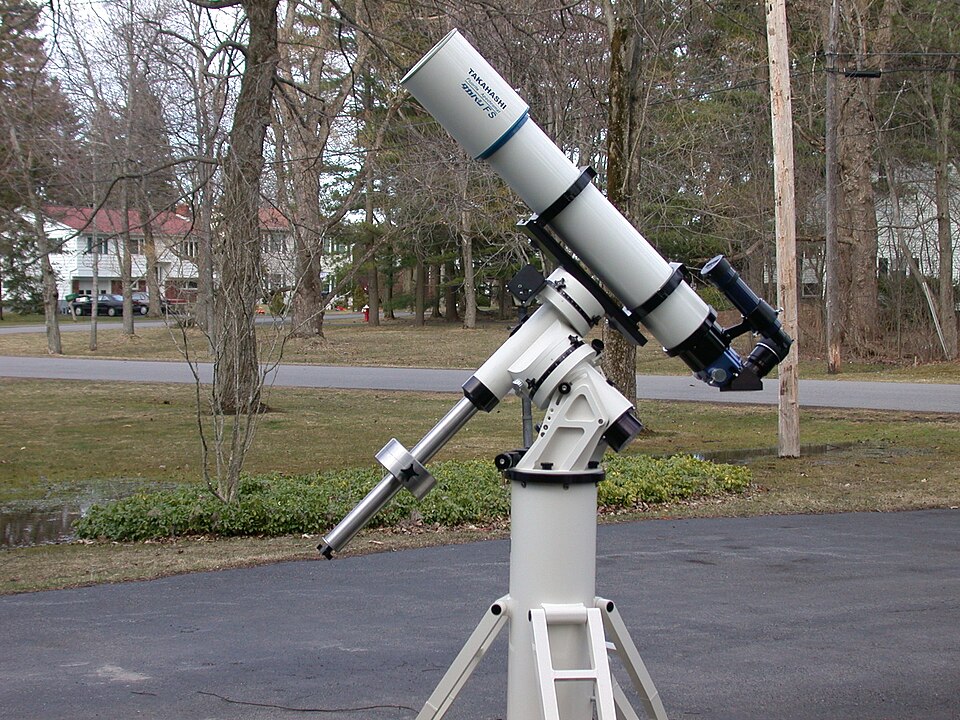
The German equatorial mount (GEM) uses worm gears in both axes and a counterweight bar to balance the telescope. It is heavy, but it carries a lot for its price, and the counterweights make it tolerant of heavy and long telescopes. Belt drives, as on Sky-Watcher's EQ6-R Pro and the new HEQ5-R Pro, reduce backlash compared with older gear-driven versions.
Strain-wave (harmonic) mounts
A strain-wave mount replaces the large worm gear with a compact harmonic drive, a flexible toothed ring inside a rigid one, that gives a very high gear reduction with no backlash in a small, light housing. The differences that matter in use:
- No counterweight, up to a point. The drive holds an unbalanced load, so most models carry their rated payload without a counterweight; adding one raises the limit. The tripod or pier then has to be stable enough on its own.
- More periodic error. The tracking of a strain-wave drive wanders more over each turn than a good worm gear, and the error is less regular, so periodic error correction removes less of it.
- Guiding is expected. For long exposures, plan on autoguiding with a guide camera and PHD2, or a model with high-resolution encoders, which costs more.
- Light and quick to set up, which is why most new mounts launched in 2025 and 2026 are strain-wave designs.
How much payload do you need?
Add up everything the mount carries: telescope, rings and dovetail, camera, filter wheel, guide scope and guide camera, focuser, dew heaters and the controller. Then choose a mount rated well above that total. Makers' ratings are maximums, and imaging needs more margin than visual use, because any shake shows in every frame; long telescopes catch the wind and need more margin still. Sky-Watcher, for example, rates the HEQ5-R Pro at 15 kg specifically for imaging.
As a rough guide from the models below: a camera and lens fits a star tracker rated at about 5 kg; a small refractor such as a RedCat or FF70 fits a strain-wave mount rated at 8 to 13 kg; a 100 mm refractor (the Esprit 100EDX weighs 7.26 kg before the camera) needs a 15 kg class mount; and a 10" Newtonian or 11" Schmidt-Cassegrain needs a 20 to 25 kg class mount.
Current mounts at a glance
| Mount | Type | Payload | Mount weight | Price (Nov 25, 2026) |
|---|---|---|---|---|
| Sky-Watcher Star Adventurer 2i | Star tracker | 5 kg | about 1.2-1.65 kg by package | $329 sale (list $395), photo package |
| iOptron SkyGuider Pro | Star tracker | 5 kg balanced | 1.0 kg head | $359 sale (list $539), full package |
| Sky-Watcher Star Adventurer GTi | Compact GoTo EQ | 5 kg | 2.6 kg | $579 sale (list $720), head kit |
| Celestron Advanced VX | Worm-gear EQ | 13.6 kg | 7.7 kg | $1,099 sale (list $1,168.95) |
| iOptron HAE18C | Strain-wave | 8.5 kg (12 kg with counterweight) | 2.82 kg | $1,299 sale at iOptron (regular $1,649) |
| ZWO AM3N | Strain-wave | 8 kg (13 kg with counterweight) | 4.1 kg | $1,349 sale (list $1,848) |
| Sky-Watcher HEQ5-R Pro | Belt-driven EQ | 15 kg (imaging) | 12 kg | $1,399 sale (list $1,695) |
| iOptron HAE16C | Strain-wave | 8.2 kg (12 kg) | 2.6 kg | $1,499 at iOptron |
| iOptron HEM27 | Strain-wave | 13.5 kg (20 kg) | 3.4 kg | $1,719 sale at iOptron (regular $2,039) |
| Sky-Watcher EQ6-R Pro | Belt-driven EQ | 20 kg | not confirmed | $1,899 sale (list $2,250), back-ordered |
| Celestron CGEM II | Worm-gear EQ | 18.1 kg | 18.1 kg | $1,899 |
| iOptron HAE29C | Strain-wave | 13.5 kg (18 kg) | 3.7 kg | $1,949 sale at iOptron (regular $2,359) |
| ZWO AM5N | Strain-wave | 15 kg (20 kg) | 5.5 kg | $1,999 sale (list $2,648) |
| Sky-Watcher Wave 150i | Strain-wave | 15 kg (25 kg) | 5.8 kg | $2,299 sale (list $2,495), back-ordered |
| iOptron HAE43C | Strain-wave | 20 kg (25 kg) | 5.7 kg | $2,639 sale at iOptron (regular $3,239) |
| ZWO AM7 | Strain-wave | 20 kg (30 kg) | 6.5-6.75 kg | $2,699 at ZWO |
| Celestron CGX | Worm-gear EQ | 24.9 kg | 20 kg | $2,699 |
| WarpAstron WD-20 | Servo strain-wave | 22 kg (30 kg) | 5.4 kg | $3,099 (sold out) |
| Pegasus Astro NYX-101 | Strain-wave | 20 kg (30 kg) | 6.4 kg | $3,182 |
For strain-wave mounts the first payload is without a counterweight and the figure in brackets with one. The classic EQ mounts all need counterweights, which are included. The ZWO AM5N figures come from High Point Scientific, because ZWO's own page was not open to the public.
Picks
- Camera and lens: the Star Adventurer 2i or SkyGuider Pro. iOptron also launched two new trackers, the PST Micro Tracker ($249 list) and HST MiniTracker ($549 list).
- Small refractor, smallest budget: the Star Adventurer GTi adds GoTo for a 5 kg load such as a RedCat 51 and a small camera.
- Classic first imaging mount: the HEQ5-R Pro (15 kg for imaging) or, with more margin, the EQ6-R Pro (20 kg). Both are heavy: the HEQ5-R Pro head alone weighs 12 kg, plus 2 × 5.3 kg of counterweights.
- Light and portable for a small refractor: the iOptron HAE18C or ZWO AM3N.
- One mount for most refractors up to 100 mm: the ZWO AM5N, iOptron HEM27 or Sky-Watcher Wave 150i.
- Heavier telescopes: the ZWO AM7 (announced January 2026) or iOptron HAE43C in strain-wave form, or the Celestron CGX if you prefer a classic mount.
Discontinued and replaced models
| Model | Status (November 25, 2026) | Replacement |
|---|---|---|
| ZWO AM5 | No longer in ZWO's mount range, which lists only the AM3N, AM5N and AM7. ZWO has not announced its end. | ZWO AM5N |
| ZWO AM3 | No longer listed by ZWO; its old product page is gone. | ZWO AM3N (2025) |
| Sky-Watcher HEQ5 Pro | Sold out with no back orders at High Point Scientific; Sky-Watcher announced the HEQ5-R Pro in November 2025 as the newer model. | Sky-Watcher HEQ5-R Pro |
| iOptron HEM15 | Marked discontinued on iOptron's site. | iOptron HAE16C or HAE18C |
| Orion Atlas EQ-G | Orion ceased operations in July 2024; see telescopes. | Sky-Watcher HEQ5-R Pro or EQ6-R Pro |
Before you buy
- Weigh your kit first, then choose a mount with margin to spare.
- Budget for guiding with a strain-wave mount: a guide scope or off-axis guider, a guide camera and a controller or laptop to run it.
- Think about the tripod or pier. Strain-wave mounts are often sold as a head only.
- Check the latitude range if you live far north or south, and whether the mount works in alt-azimuth mode too (most strain-wave mounts here do).
- Mainly observing visually? Our sister site covers telescope mounts from that side.
Sources
- highpointscientific.com/skywatcher-star-adventurer-2i-mount-... (Star Adventurer 2i payload and price)
- ioptron.com/product-p/3550.htm (iOptron SkyGuider Pro payload and price)
- ioptron.com/category-s/111.htm (iOptron PST Micro Tracker and HST MiniTracker prices)
- skywatcher.com/product/star-adventurer-gti (Star Adventurer GTi payload and weight)
- highpointscientific.com/sky-watcher-staradventurer-gti-head-... (Star Adventurer GTi price)
- highpointscientific.com/celestron-advanced-vx-avx-equatorial... (Celestron AVX payload, weight, price)
- skywatcher.com/product/heq5-r-pro (HEQ5-R Pro belt drive, 15 kg imaging payload, weight, counterweights)
- highpointscientific.com/sky-watcher-heq5-r-mount (HEQ5-R Pro price)
- highpointscientific.com/sky-watcher-heq5-pro-computerized-eq... (HEQ5 Pro sold out, no back orders)
- skywatcher.com/product/eq6r-pro (EQ6-R Pro payload and counterweights)
- highpointscientific.com/sky-watcher-eq6-r-pro-mount-s30300 (EQ6-R Pro price)
- highpointscientific.com/celestron-cgem-ii-equatorial-mount-9... (Celestron CGEM II payload and price)
- highpointscientific.com/celestron-cgx-equatorial-mount-91530 (Celestron CGX payload, weight, price)
- ioptron.com/product-p/he182c.htm (iOptron HAE18C specs and price)
- ioptron.com/product-p/he162c.htm (iOptron HAE16C specs and price)
- ioptron.com/product-p/h272.htm (iOptron HEM27 specs and price)
- ioptron.com/product-p/he292c.htm (iOptron HAE29C specs and price)
- ioptron.com/product-p/he432c.htm (iOptron HAE43C specs and price)
- ioptron.com/product-p/h152.htm (iOptron HEM15 discontinued)
- zwoastro.com/product/am3n (ZWO AM3N specs)
- highpointscientific.com/zwo-am3-harmonic-drive-equatorial-mo... (ZWO AM3N price)
- highpointscientific.com/zwo-am5n-harmonic-drive-equatorial-m... (ZWO AM5N specs and price)
- zwoastro.com/product/am7 (ZWO AM7 specs and price)
- zwoastro.com/product-category/mounts (ZWO's current mounts are the AM3N, AM5N and AM7)
- skywatcher.com/product/wave-150i (Sky-Watcher Wave 150i specs)
- highpointscientific.com/sky-watcher-wave-150i-strainwave-mou... (Wave 150i price)
- highpointscientific.com/pegasus-astro-nyx-101-v2-harmonic-ge... (Pegasus NYX-101 specs and price)
- highpointscientific.com/warpastron-warpdrive-wd-20-harmonic-... (WarpAstron WD-20 price, sold out)
- warpastron.com (WarpAstron WD-20 specs)