Top Webcams for Webcam Astronomy in 2026
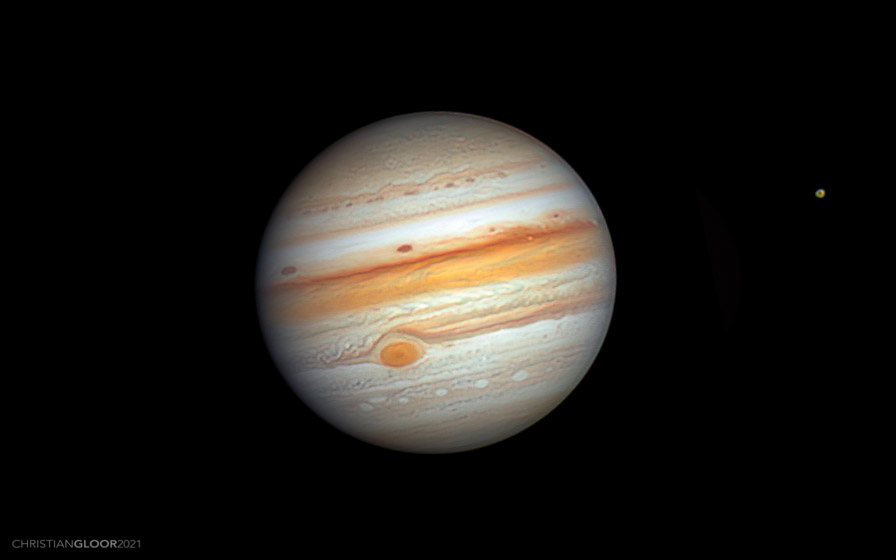

Webcam astronomy started with ordinary webcams pushed into a telescope's eyepiece holder. You record a short video of the Moon or a planet, and software keeps and stacks the sharpest frames, the ones taken in the instants when the air was steady. The method has not changed, but the cameras have: today the same job is done by small planetary cameras that plug into a laptop's USB port like a webcam, with Sony sensors far more sensitive than any webcam's.
How we chose. Every camera below was on sale new on November 12, 2026, from its maker or a large dealer. The specifications come from the makers' own product pages and manuals (listed under Sources). Prices are what the maker's own store listed that day, or High Point Scientific for QHYCCD, which sells only through dealers. Several were Black Friday sale prices, marked below, and prices change often.
The picks at a glance
| Camera | Sensor | Resolution | Pixel size | Full-frame speed | Price (Nov 12, 2026) | Best for |
|---|---|---|---|---|---|---|
| ZWO ASI662MC | Sony IMX662 | 1920 × 1080 | 2.9 µm | 107.6 fps | $199 ($179 on sale) | A first planetary camera |
| Player One Mars-C | Sony IMX462 | 1944 × 1096 | 2.9 µm | 136 fps | $139 | The smallest budget |
| ZWO ASI664MC | Sony IMX664 | 2704 × 1536 | 2.9 µm | 95 fps | $299 | Planets with their moons |
| SVBONY SV705C | Sony IMX585 | 3856 × 2180 | 2.9 µm | 45 fps | $294.99 on sale | The Moon and the Sun |
| ZWO ASI715MC | Sony IMX715 | 3864 × 2192 | 1.45 µm | 45.1 fps | $199 | Small telescopes, no Barlow |
| Logitech C922 Pro Stream | not published | 1920 × 1080 | not published | 30 fps | $119.99 | A first experiment only |
Full-frame speed is the fastest rate the maker quotes at full resolution over USB 3.0, usually in 8-bit mode. All the planetary cameras run faster when you record only a smaller region around the planet.
The picks
1. Best first planetary camera: ZWO ASI662MC
The ASI662MC is ZWO's entry-level planetary camera and the successor to the ASI224MC, which topped this list in 2024 and is no longer made. Its 1920 × 1080 sensor has small 2.9 µm pixels, low read noise and, according to ZWO, no amp glow. It records up to 107.6 frames per second, which ZWO describes as "reliable support for planetary observation."
- Sensor: Sony IMX662, color, 6.45 mm diagonal
- Speed: 107.6 fps at full resolution over USB 3.0 (20.9 fps over USB 2.0)
- Read noise: from 0.8 e⁻ (ZWO)
- Extras: ST4 guide port, so it can double as a guide camera
- Window: AR-coated glass, not an IR-cut filter (add a UV/IR-cut filter, see below)
- Price: $199 at ZWO's US store ($179 in its Black Friday sale)
Same sensor, other makers: Player One Mars-C II ($199, 108 fps), SVBONY SV305C Pro ($184.99 on sale, 99 fps) and ToupTek G3M662C ($179 on sale, 103.4 fps at 8-bit). Their makers' figures differ a little, but they are built around the same Sony sensor.
2. Lowest price: Player One Mars-C
At $139 the Mars-C is the cheapest current USB 3.0 planetary camera we found. It is also the oldest design here (Player One released it in December 2020), built on the Sony IMX462, which has the same 2.9 µm pixels and 1080p-class resolution as the IMX662 cameras above. Player One quotes 136 fps at full resolution in 8-bit mode.
- Sensor: Sony IMX462, color, 1944 × 1096
- Speed: 136 fps (10-bit, USB 3.0); 64 fps in 12-bit
- Read noise: from 0.7 e⁻ (Player One)
- Extras: ST4 guide port
- Price: $139 at Player One's online store (prices in US dollars, ships worldwide)
Same sensor, other makers: the QHY5III462C ($202 at High Point Scientific) costs more but comes with both an IR-cut filter and an IR850 filter for infrared imaging.
3. More room around the planet: ZWO ASI664MC
The ASI664MC keeps the 2.9 µm pixels and high speed of the cameras above on a larger sensor: 9.02 mm across the diagonal instead of about 6.5 mm. That gives more room around a planet, which helps with Jupiter's moons and makes it easier to keep a planet in the frame on a mount that tracks less precisely.
- Sensor: Sony IMX664, color, 2704 × 1536 (4.15 MP)
- Speed: 95 fps at full resolution (10-bit, USB 3.0)
- Read noise: from 0.46 e⁻ (ZWO)
- Extras: ST4 guide port; AR window, so add a UV/IR-cut filter
- Price: $299 at ZWO's US store
Same sensor, other makers: Player One Neptune 664C ($279, 93 fps), released in September 2023.
4. For the Moon and the Sun: SVBONY SV705C
The Moon and the Sun are far bigger than any planet, so here sensor size matters most. The Sony IMX585 in these cameras measures 12.84 mm across the diagonal, about twice the width of the 1080p cameras above, at 3856 × 2180 pixels. At full resolution it records 45 fps; for planets you record a smaller region instead, and SVBONY quotes 187 fps at 1920 × 1080.
- Sensor: Sony IMX585, color, 8.3 MP
- Speed: 45 fps at full resolution, 187 fps at 1920 × 1080 (USB 3.0)
- Read noise: from 0.7 e⁻ (SVBONY)
- Extras: ST4 guide port; AR-coated window (SVBONY also sells it bundled with a UV/IR-cut filter)
- Price: $294.99 at SVBONY's store, a sale price (the listed regular price is $419.99)
Same sensor, other makers: ZWO ASI585MC ($399, or $359 in ZWO's Black Friday sale), Player One Uranus-C ($369) and QHY5III585C ($399 at High Point Scientific, IR-cut window, IR850 filter included).
Solar imaging needs a proper solar filter over the front of the telescope, or a dedicated solar telescope. Never point a telescope or camera at the Sun without one.
5. No Barlow needed: ZWO ASI715MC
Planetary imagers usually add a Barlow lens to enlarge the planet on the sensor. The ASI715MC's pixels are only 1.45 µm across, half the size of the others here, so it records fine detail with less magnification: ZWO says it gives "very sharp object details in use even without a Barlow lens." A review published on QHYCCD's site makes the same point for cameras with pixels of 2 µm or less: a Schmidt-Cassegrain, or even an f/7 refractor, can be used at its native focal length.
- Sensor: Sony IMX715, color, 3864 × 2192 (8.46 MP), 6.43 mm diagonal
- Speed: 45.1 fps at full resolution (10-bit, USB 3.0)
- Read noise: from 0.72 e⁻ (ZWO)
- The trade-off: each pixel holds only about 6,000 electrons (full well 6.03 ke⁻, against 38.2 ke⁻ for the ASI662MC), which leaves less dynamic range in each frame
- Price: $199 at ZWO's US store
Same sensor, other makers: ToupTek G3M715C ($179), SVBONY SC715C ($229.99 on sale, released in 2025) and QHY5III715C ($229 at High Point Scientific). In between: the ZWO ASI678MC ($299) has 2.0 µm pixels on a 3840 × 2160 sensor and runs at 47.5 fps.
What about a real webcam?
You can still do webcam astronomy with an actual webcam, and it is a cheap way to try the method. The Logitech C922 Pro Stream ($119.99 at Logitech) records 1080p at 30 fps or 720p at 60 fps; the C920s ($69.99) records 1080p and 720p at 30 fps. To use either on a telescope you have to remove its lens and fit an adapter that slides into the focuser. Logitech publishes no sensor size, pixel size or noise figures for them, because they are designed for video calls and streaming, not for telescopes.
For about $19 more than the C922, the Player One Mars-C above records up to 136 fps, and its maker publishes the sensor, pixel size and noise figures you need to set it up. Unless you already own a webcam you are happy to take apart, a planetary camera is the better buy.
What happened to our 2024 picks
| 2024 pick | November 2026 |
|---|---|
| ZWO ASI224MC | Out of stock at ZWO, which sends buyers to its dealers. Agena Astro lists it as discontinued by the manufacturer and names the ASI662MC (pick 1) as its successor. |
| QHY5III290C | QHYCCD lists it as discontinued in 2020. QHY's QHY5III462C has the same pixel size and resolution. |
| Logitech C922 Pro Stream | Still sold, $119.99. See "What about a real webcam?" above. |
| SVBONY SV305 | The original model (Sony IMX290 sensor) is no longer sold on SVBONY's site. SVBONY calls the SV305C (USB 2.0, 24 fps, $163.99 on sale) "an upgrade on the basis of SV305", and its old SV305 Pro page now sells the SV305C Pro (USB 3.0, 99 fps); both use the IMX662. |
| RisingCam G3M178 | We could not find an official RisingCam website (risingcam.com is a parked domain). ToupTek sells a G3M178C with the same Sony IMX178 sensor (3040 × 2048, 2.4 µm) for $239. |
Before you buy
- Get USB 3.0, and use a USB 3.0 port. The frame rate is what makes lucky imaging work. SVBONY's SV305C and SV305C Pro use the same sensor, yet the USB 2.0 model manages 24 fps and the USB 3.0 model 99 fps. ZWO's ASI662MC drops from 107.6 fps to 20.9 fps on a USB 2.0 port.
- Budget for a UV/IR-cut filter. Most of these color cameras (all the ZWO and Player One models, the SVBONY SV705C, the QHY5III715C) have a clear AR-coated window that lets infrared light through, so add a UV/IR-cut filter for natural color (ZWO sells them as accessories for its cameras). Exceptions: the SVBONY SV305C has one built in, the QHY5III585C and QHY5III678C have an IR-cut window, and the QHY5III462C comes with an IR-cut filter. ToupTek offers its cameras with either window.
- Match the pixels to your telescope. The review on QHYCCD's site puts the best focal ratio for planets at about five times the pixel size in microns. For 2.9 µm pixels that is about f/15, so a typical f/10 Schmidt-Cassegrain needs a Barlow lens; for the 1.45 µm cameras it is about f/7. On the Moon and the Sun, a large sensor matters more than small pixels.
- Color or mono? Every pick here is a color camera, the simple choice for a first camera. Several also come in monochrome versions (the ZWO ASI662MM and ASI585MM, the Player One Mars 662M and Uranus-M, both released in 2025), which need separate color filters, usually in a filter wheel, to make a color image.
- Software. Capture the video with one of the programs in our image capture software guide, then stack it as described in video integration software. New to the method? Start with the webcam astronomy basics.
Our older round-up, Top Webcams for Astrophotography, covers some earlier models that may still turn up second-hand.
Sources
- zwoastro.com/product/asi662mc (ZWO ASI662MC sensor, resolution, pixel size, 107.6 fps)
- i.zwoastro.com/wp-content/uploads/2026/01/6b176cccbe31232e66... (ZWO ASI662MC manual, AR window, ST4 port, full well, USB 2.0 frame rate)
- us.zwoastro.com/products/asi662mc (ZWO ASI662MC price)
- zwoastro.com/product/zwo-asi224mc (ZWO ASI224MC out of stock at ZWO)
- agenaastro.com/zwo-asi224mc-cmos-color-astronomy-imaging-cam... (ZWO ASI224MC discontinued by the manufacturer, ASI662MC as its successor)
- player-one-astronomy.com/product/mars-c-ii-usb3-0-color-came... (Player One Mars-C II specs and price)
- svbony.com/products/sv305c-pro-camera (SVBONY SV305C Pro specs and price)
- touptekastro.com/products/g3m662c (ToupTek G3M662C specs and price)
- player-one-astronomy.com/product/mars-color-camera (Player One Mars-C specs and price)
- player-one-astronomy.com/planetary-camera (Player One release dates (Mars-C 2020, Mars-C II and Uranus-C 2022, Neptune 664C 2023))
- qhyccd.com/planetary-camera-qhy5iii462c (QHY5III462C specs, IR-cut and IR850 filters included, same pixel size and resolution as the QHY5III290)
- highpointscientific.com/qhy-qhy5iii462-planetary-color-and-n... (QHY5III462C price)
- i.zwoastro.com/wp-content/uploads/2024/01/8c3516e9c63686f7ea... (ZWO ASI664MC manual, sensor diagonal, resolution, 95 fps; calls the ASI662MC ZWO's entry-level planetary camera)
- us.zwoastro.com/products/asi664mc (ZWO ASI664MC price)
- player-one-astronomy.com/product/neptune-664c-usb3-0-color-c... (Player One Neptune 664C specs and price)
- svbony.com/products/sv705c-color-planetary-camera-imx585 (SVBONY SV705C specs, 45 fps full frame, 187 fps at 1920 x 1080, ST4 port, price)
- zwoastro.com/product/asi585mc-mm (ZWO ASI585MC specs)
- us.zwoastro.com/products/asi585mc-mm (ZWO ASI585MC price)
- player-one-astronomy.com/product/uranus-c-usb3-0-color-camer... (Player One Uranus-C specs and price)
- qhyccd.com/qhy5iii585 (QHY5III585C specs and filters)
- sony-semicon.com/files/62/flyer_security/IMX585-AAQJ1_Flyer.... (Sony IMX585 sensor size (12.84 mm diagonal))
- zwoastro.com/product/asi715mc (ZWO ASI715MC sensor, resolution, 1.45 µm pixels, full well)
- i.zwoastro.com/wp-content/uploads/2024/01/dc47667de780f2f363... (ZWO ASI715MC manual, frame rates, no Barlow lens needed)
- us.zwoastro.com/products/asi715mc (ZWO ASI715MC price)
- touptekastro.com/products/g3m715c (ToupTek G3M715C specs and price)
- svbony.com/products/sc715c-planetary-camera (SVBONY SC715C specs and price)
- qhyccd.com/qhy5iii715c (QHY5III715C specs)
- qhyccd.com/unveiling-the-qhy5iii715c-and-qhy5iii678m-initial... (review on QHYCCD's site, best planetary focal ratio about 5x the pixel size, no Barlow needed with pixels of 2 µm or less)
- zwoastro.com/product/zwo-asi678mc (ZWO ASI678MC specs)
- us.zwoastro.com/products/zwo-asi678mc (ZWO ASI678MC price)
- logitech.com/en-us/products/webcams/c922-pro-stream-webcam.9... (Logitech C922 Pro Stream video modes and price)
- logitech.com/en-us/shop/p/c920s-pro-hd-webcam (Logitech C920s video modes and price)
- qhyccd.com/discontinued-products (QHY5III290C discontinued in 2020)
- svbony.com/blog/full-upgrade-of-the-original-camera (SVBONY SV305C as the upgrade of the original SV305)
- svbony.com/products/sv305c-planetary-camera (SVBONY SV305C specs, USB 2.0 at 24 fps, built-in UV/IR-cut window, price)
- touptekastro.com/products/g3m178c (ToupTek G3M178C specs and price)