Smart Telescope vs. Traditional Astrophotography Setup
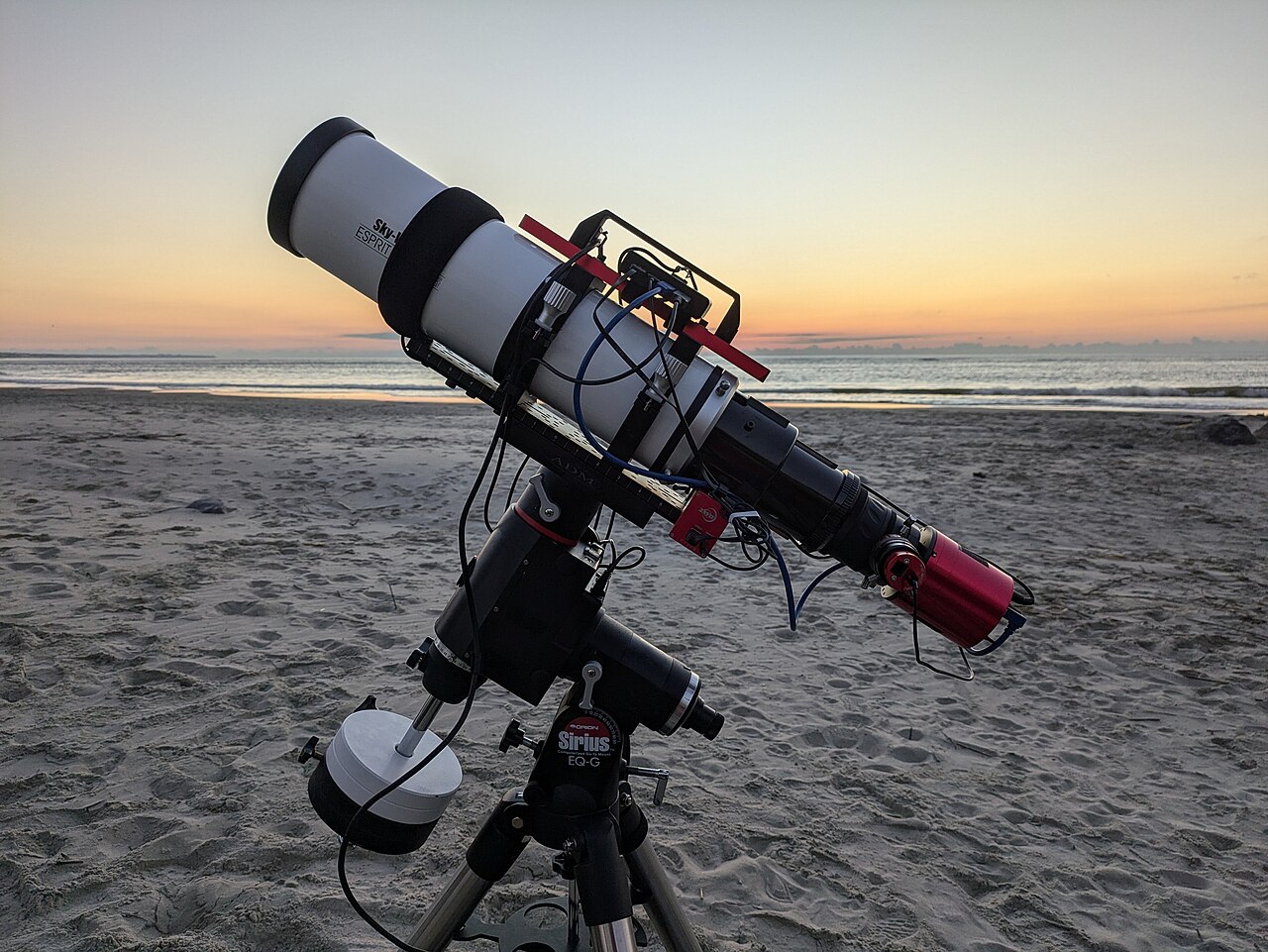

A smart telescope and a traditional imaging rig are built from the same parts: a telescope, a camera, a tracking mount and a computer. The smart telescope seals them into one box with an app; the traditional rig keeps them separate, so you choose, connect and set up each one. This page compares the two with real prices. If you are new to smart telescopes, read what they are and how they work first.
Prices are from High Point Scientific on November 25, 2026, Black Friday week, except the ZWO cameras (ZWO's US store, November 12, 2026, also sale prices). Sale prices are marked, with the regular price in brackets.
The traditional setup
A typical small deep-sky rig in 2026 has four parts:
- A small refractor or astrograph. A short, fast apochromat with a flat field, such as a William Optics RedCat or Askar SQA. See telescopes and astrographs.
- An astronomy camera. A dedicated camera without a lens, connected over USB. See our planetary cameras (several also work for deep sky) and digital cameras if you would rather use a DSLR or mirrorless body.
- An equatorial mount. A motorized mount with one axis aligned to the celestial pole, so the field does not rotate. See mounts for astrophotography.
- A control computer. A ZWO ASIAIR or StellarMate box run from a phone or tablet, or a mini PC with free software such as N.I.N.A. See astro imaging computers.
Add the adapters and spacers that join camera and telescope (see camera-to-telescope adapters), a 12 V power supply and, later, a guide camera.
Same optics, different packaging
The ZWO Seestar S50 Pro and a small traditional rig can be almost identical optically. Compare the S50 Pro with a William Optics RedCat 51 and a ZWO ASI585MC:
| ZWO Seestar S50 Pro | RedCat 51 Gen 3 + ZWO ASI585MC | |
|---|---|---|
| Aperture | 50 mm | 51 mm |
| Focal length, f-ratio | 260 mm, f/5.2 | 250 mm, f/4.9 |
| Sensor | 1/1.2-inch, 3840 × 2160, 2.9 µm pixels | Sony IMX585, 1/1.2-inch, 3840 × 2160, 2.9 µm pixels |
| Field of view | 2.8° (ZWO's figure) | about 2.5° × 1.4° |
| Mount | alt-az, EQ mode on ZWO's tripod head | equatorial (in the kit below) |
| Weight | 2.8 kg, everything included | telescope 1.77 kg, mount head 2.6 kg, plus camera, counterweight, tripod and battery |
| Price (Nov 25, 2026) | $999 | about $2,171 for the kit below |
The rig's field of view is calculated from the IMX585's 11.2 × 6.3 mm sensor and the 250 mm focal length; the Vaonis Vespera II, which uses the same sensor at 250 mm, lists the same 2.5° × 1.4°. So for the same aperture, focal length and sensor format, the traditional version costs more than twice as much. What the extra money buys is not a better picture of the same target on the same night, but control and room to grow.
Pricing out a traditional rig
A small kit to match a 50 mm smart telescope
| Part | Example | Price (Nov 25, 2026) |
|---|---|---|
| Telescope | William Optics RedCat 51 Gen 3 (51 mm, 250 mm f/4.9, 1.77 kg) | $834.10 sale ($878) |
| Camera | ZWO ASI585MC (Sony IMX585, uncooled) | $359 sale ($399), ZWO US store, Nov 12 |
| Mount | Sky-Watcher Star Adventurer GTi head kit (5 kg payload, counterweight included) | $579 sale ($720) |
| Controller | ZWO ASIAIR Plus 256GB | $399 |
| Total | $2,171.10 on sale ($2,396 at regular prices) |
Not included: a tripod (High Point sells the GTi with one for about $100 more, according to a search-engine extract), adapters and spacers (about $18 each from ZWO), a 12 V power supply (the ASIAIR comes without one), and a UV/IR-cut or dual-band filter. The ASI585MC has a clear protective window, not an IR-cut filter.
A larger kit
| Part | Example | Price (Nov 25, 2026) |
|---|---|---|
| Telescope | William Optics RedCat 61 (61 mm, 300 mm f/4.9, 2.46 kg) | $1,147.60 sale ($1,208) |
| Camera | ZWO ASI585MC | $359 sale ($399), Nov 12 |
| Mount | ZWO AM3N strain-wave mount (8 kg without counterweight, 4.1 kg) | $1,349 sale ($1,848) |
| Controller | ZWO ASIAIR Plus 256GB | $399 |
| Total | $3,254.60 on sale ($3,854 at regular prices) |
That is more than a Vaonis Vespera Pro 2 ($2,490 on sale) and less than a Celestron Origin Mark II ($4,299), and the mount would carry a much bigger telescope later. The Origin's own optics are sold separately too: the Celestron RASA 6 (152 mm, f/2.2) was listed at $1,699 by Astronomy magazine in October 2026.
Ways to change the cost
- A mini PC instead of an ASIAIR. N.I.N.A. is free, but you still need the PC (ScopeTrader priced one suitable mini PC at $239 in April 2025) and usually a power hub such as the Pegasus Astro Pocket Powerbox Advance Gen3 ($372.90, preorder). That is not cheaper than an ASIAIR, but it runs any Windows astronomy program.
- A camera with the ASIAIR built in. ZWO's ASI585MC Air costs $719 to $899 depending on the bundle, against $758 for the separate camera and ASIAIR Plus at sale prices.
- A cooled camera. A cooled camera holds its sensor at a set temperature, so dark frames match from night to night. It costs more than the uncooled ASI585MC; we have not priced one here.
What a smart telescope gives you
- Setup in minutes. Put it on a tripod, open the app, and it plate solves and finds targets by itself; Astronomy magazine timed the Origin's alignment at about a minute. A traditional rig needs balancing, polar alignment, focusing and cabling every night unless it stays set up.
- One box to carry. The S50 Pro weighs 2.8 kg with its battery. The small kit above weighs more than that in telescope and mount head alone, before the tripod, counterweight and battery.
- Nothing to learn first. Live stacking shows a result on the first night. A traditional rig involves capture software, autoguiding (with PHD2) and stacking and processing software such as Siril, each with its own learning curve.
- A lower price at the small end. At 50 mm, the smart telescope costs less than half as much as the equivalent parts.
What a traditional rig gives you
- No field rotation. An equatorial mount follows the sky around the pole, so exposures can be as long as the mount tracks accurately. Smart telescopes in alt-az mode are limited to short subs (the DWARF Draco, which rotates its sensor, is the exception); the S50 Pro allows 60-second exposures only in EQ mode.
- Any focal length. You can put a short refractor on the mount for big nebulae, then a long telescope for small galaxies. A smart telescope has one focal length (Vaonis plans more module sizes for its modular Atlas).
- Planets. With a long-focal-length telescope and a planetary camera such as the ZWO ASI662MC ($179 on sale, $199 regular), you can do proper lucky imaging with video integration, which no smart telescope does well.
- An upgrade path. Replace one part at a time: a cooled or monochrome camera, a larger telescope, a stronger mount. A smart telescope is mostly replaced as a whole (Celestron's camera upgrade for the original Origin is an exception), and Sky at Night notes that even the Origin Mark II's small, uncooled camera leaves much of the RASA's flat field unused.
- Your own camera. The ASIAIR Plus works with nearly 100 Canon and Nikon DSLR and mirrorless bodies as well as ZWO cameras.
- Full control of the data. Every sub is a raw file you choose the exposure, gain and filter for. Smart telescopes can save raw frames too, but you work within the app's settings.
Which should you pick?
Choose a smart telescope if you want deep-sky pictures with little setup, have limited time or storage space, travel to dark sites, observe with family or groups, or are not sure yet how far you will take the hobby. Start with the best smart telescopes in 2026.
Choose a traditional rig if you want planets as well as deep sky, want to change focal lengths, already own a camera or telescope, enjoy the technical side, or expect to keep upgrading. A small refractor on a light equatorial mount is the classic start; see mounts and astrographs, and our sister site's guide to choosing a telescope if you also want to observe visually.
The two are converging. The ASIAIR already runs a traditional rig from a phone app, much like a smart telescope. In the other direction, the Seestar S50 Pro supports ASCOM Alpaca, so N.I.N.A. can control it as part of a traditional imaging workflow, and its raw FITS frames can be processed in the same image processing software. Owning both is a reasonable end point too: a smart telescope for quick nights and travel, and a rig for long projects.
Sources
- zwoastro.com/product/seestar-s50-pro (Seestar S50 Pro specifications (50 mm, 260 mm f/5.2, 1/1.2-inch 3840 x 2160 sensor with 2.9 µm pixels, 2.8 degree field, 2.8 kg, up to 9 h), EQ mode limits)
- highpointscientific.com/zwo-seestar-s50-pro-smart-telescope (Seestar S50 Pro $999 on November 25, 2026)
- zwoastro.com/2026/08/25/seestar-s50-pro-now-available-50mm-a... (Seestar S50 Pro supports ASCOM Alpaca and N.I.N.A.)
- vaonis.com/pages/product/vespera-ii (Vespera II with the Sony IMX585 at 250 mm gives a 2.5 x 1.4 degree field at 2.39 arcseconds per pixel)
- vaonis.com/pages/vespera-new-generation (Vespera Pro 2 specifications)
- highpointscientific.com/vaonis-vespera-pro-2-vep50-ii (Vespera Pro 2 $2,490 sale, $2,990 list)
- space.com/stargazing/skywatching-kit/celestron-origin-intell... (Origin Mark II 152 mm f/2.2, 18.6 kg assembled, $4,299)
- astronomy.com/observing/our-16th-annual-star-products (Celestron RASA 6 (152 mm, 335 mm, f/2.2) $1,699, the tube inside the Origin)
- astronomy.com/observing/appraising-the-origin-home-observato... (Origin aligns itself in about a minute)
- highpointscientific.com/william-optics-redcat-51-gen-3-apo-f... (William Optics RedCat 51 Gen 3 51 mm, 250 mm f/4.9, 1.77 kg, $834.10 sale, $878 list)
- highpointscientific.com/william-optics-wifd-redcat-61-refrac... (William Optics RedCat 61 61 mm, 300 mm f/4.9, 2.46 kg, $1,147.60 sale, $1,208 list)
- highpointscientific.com/askar-sqa55-quintuplet-refractor (Askar SQA55 flat-field quintuplet refractor)
- zwoastro.com/product/asi585mc-mm (ZWO ASI585MC Sony IMX585 1/1.2-inch 11.2 x 6.3 mm, 3840 x 2160, 2.9 µm, uncooled)
- us.zwoastro.com/products/asi585mc-mm (ZWO ASI585MC $359 sale, $399 regular (November 12, 2026))
- us.zwoastro.com/products/asi662mc (ZWO ASI662MC $179 sale, $199 regular (November 12, 2026))
- skywatcher.com/product/star-adventurer-gti (Sky-Watcher Star Adventurer GTi payload 5 kg, head 2.6 kg, counterweight included)
- highpointscientific.com/sky-watcher-staradventurer-gti-head-... (Star Adventurer GTi head kit $579 sale, $720 list)
- zwoastro.com/product/am3n (ZWO AM3N strain-wave mount, 8 kg payload without counterweight, 4.1 kg)
- highpointscientific.com/zwo-am3-harmonic-drive-equatorial-mo... (ZWO AM3N $1,349 sale, $1,848 list)
- highpointscientific.com/zwo-asiair-plus-wifi-camera-controll... (ZWO ASIAIR Plus 256GB $399, power supply not included, supports ZWO cameras and nearly 100 Canon and Nikon bodies)
- zwoastro.com/product-category/cameras (ZWO ASI585MC Air (ASIAIR built in) $719 to $899)
- highpointscientific.com/zwo-m42-m42-extender-spacer-21mm-lon... (ZWO 21 mm M42 spacer about $18 (search extract, undated))
- nighttime-imaging.eu (N.I.N.A. is free and open source)
- scopetrader.com/astro-imaging-pc-the-mele-quieter-4c (example astro mini PC at $239 (April 2025))
- highpointscientific.com/pegasus-astro-pocket-powerbox-advanc... (Pegasus Astro Pocket Powerbox Advance Gen3 $372.90, preorder)
- openphdguiding.org (PHD2 autoguiding, free and open source)
- siril.org (Siril is free and open source)
- dwarflab.com/us/pages/draco-smart-telescope (Draco 300 s maximum exposure)
- vaonis.com/pages/product/atlas (Atlas roadmap with more module sizes)
- celestron.com/products/celestron-origin-678c-camera (Origin 678C camera upgrade for the original Origin (via search extract))
- celestron.com/blogs/knowledgebase/what-is-field-rotation-how... (field rotation on alt-az mounts; a polar-aligned equatorial mount removes it)
- skyatnightmagazine.com/reviews/celestron-origin-mark-ii-inte... (Origin Mark II camera is an uncooled sensor that leaves much of the RASA's field unused; a session cannot be paused)